BellyFlush Official Website › Blog › Marshmallow, Slippery Elm, Fennel and Triphala
What Do Marshmallow Root, Slippery Elm, Fennel and Triphala Do in BellyFlush?
Around the three laxatives, BellyFlush adds gentler plants. Marshmallow root and slippery elm make a slippery gel in water. Fennel is a classic wind-easing seed. Triphala is a three-fruit Ayurvedic blend and the mildest mover. Research on each is thin or uses different preparations, and the label publishes no amount for any of them.
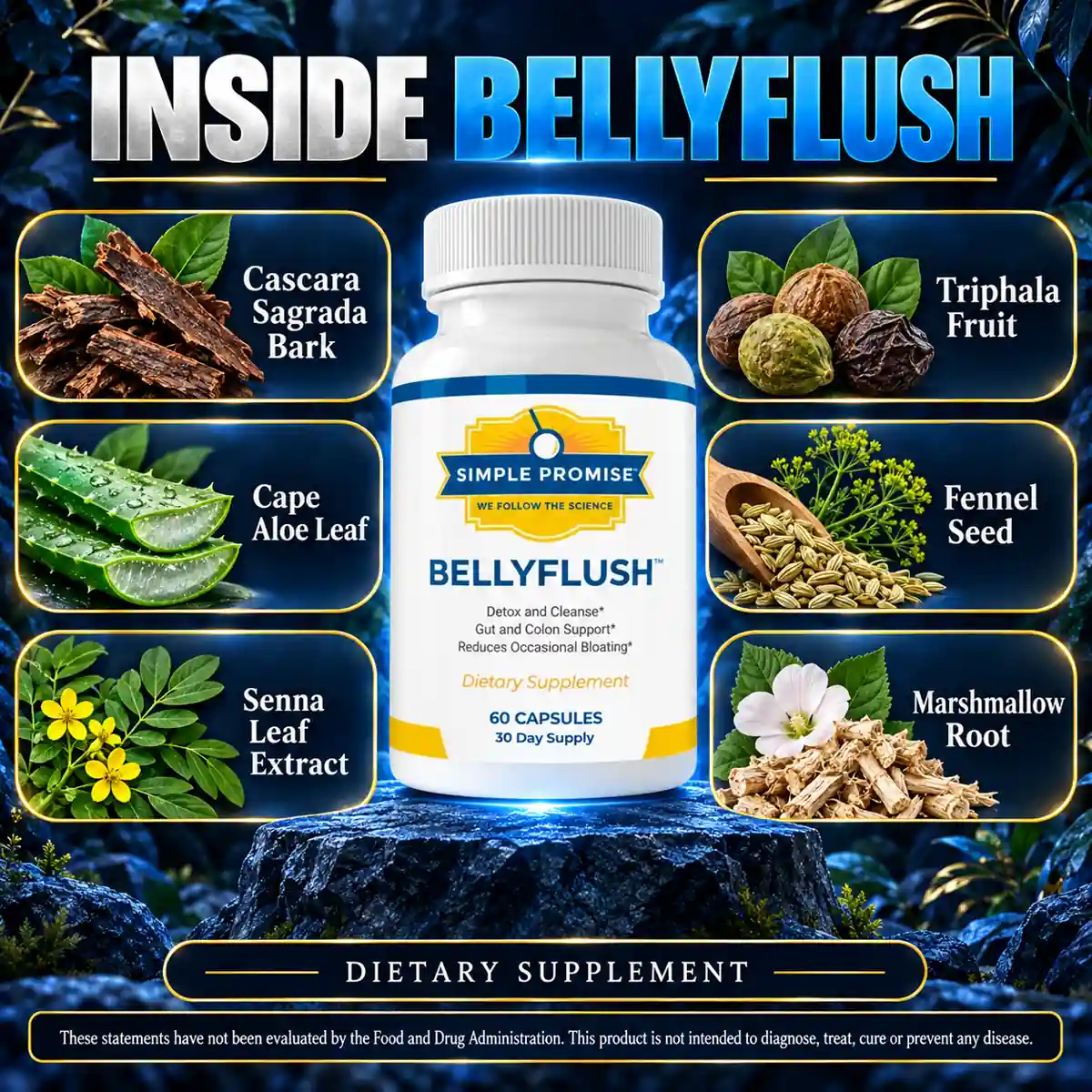
- Marshmallow root and slippery elm bark are demulcents. In water they form a slippery gel that coats and soothes.
- Fennel seed is a carminative, traditionally used to ease trapped wind and cramping.
- Triphala is three fruits, usually in equal parts, and is the mildest mover on the panel.
- These plants change how the night feels. They do not replace the three laxatives.
- No amount is published for any of them, so published trials cannot be laid over this capsule.
- Water matters. The label asks for 8 oz so the gel plants have something to hydrate in.
What job do the gentler botanicals do on this panel?
Picture the panel as a small crowd. Three plants do the heavy lifting: cascara sagrada bark, cape aloe leaf and senna leaf extract, all stimulant laxatives. The plants named in this post stand around them.
Their role is to change the experience, not to add to the effect. On a panel built around three purgatives, the soothing and wind-easing plants are there to make the night tolerable. That is a fair design idea. It is also a claim nobody has tested on this exact capsule.
What does marshmallow root do?
Marshmallow root, Althaea officinalis, is mucilaginous. In water it forms a slippery gel, and that gel is the whole traditional reason for using it: it coats and soothes a bowel that has been stimulated.
The mucilage itself is well described. Rownaghi 2024 measured the extracted polysaccharide in detail. What does not exist, as far as this desk can find, is a randomized controlled trial of oral marshmallow root for any digestive goal in adults.
That distinction is the point. A laboratory paper on a plant sugar is not a clinical result, and the NIH Office of Dietary Supplements is a short primer on reading the difference.
What does slippery elm bark do?
Slippery elm, Ulmus rubra, is the second demulcent, and traditionally the gentler one. The inner bark forms the same kind of mucilage as marshmallow root.
The research is modest. Hawrelak 2010 was a small pilot study of two natural medicine formulations in irritable bowel syndrome, one of which contained slippery elm. It was a pilot, and the herb sat inside a combination. Hawrelak 2020 places it in the wider picture of western herbs for the condition.
Nobody has run a properly powered trial of slippery elm alone for bloating. That is the honest state of the evidence.
What does fennel seed add?
Fennel, Foeniculum vulgare, is a carminative. In plain words, it is a seed used for centuries to ease trapped wind and cramping. On this panel it makes the experience easier rather than adding to the laxative effect.
Portincasa 2016 was a randomized trial of curcumin and fennel essential oil in irritable bowel syndrome, and it reported improved symptoms and quality of life. It used an essential oil at a stated dose inside a two-ingredient combination. This label names fennel seed with no amount and no extraction detail, so the read-across is weak.
What is triphala, and why is it three fruits?
Triphala is not one plant. It is three fruits, amalaki, bibhitaki and haritaki, usually in equal parts. It is the mildest mover on the panel and the one with the longest record of traditional use.
Tarasiuk 2018 is the most useful modern overview of what is proposed for functional gut disorders and what has actually been measured. Munshi 2011 was an open-label prospective study of a triphala-based formulation in functional constipation.
Open-label means everyone knew what they were taking. In a condition judged by how you feel, where placebo response runs high, that is a real limit.
How do the four compare at a glance?
| Botanical | Plant | Role | Best-known research | Read-across to BellyFlush |
|---|---|---|---|---|
| Marshmallow root | Althaea officinalis | Demulcent root | Lab work on the mucilage. No oral adult trial found | None |
| Slippery Elm bark | Ulmus rubra | Demulcent bark | A small pilot, inside a combination | Weak |
| Fennel seed | Foeniculum vulgare | Carminative seed | Essential oil with curcumin in IBS at a stated dose | Weak |
| Triphala fruit | Amalaki, Bibhitaki, Haritaki | Ayurvedic fruit blend | An overview and an open-label study | Limited |
Every row ends with Not published for the amount in this capsule. That one blank is why the right-hand column is so cautious.
Why does water matter more with these plants?
Gel plants need water to become a gel. That is why the serving is two capsules with 8 oz of water, 20 to 30 minutes before bed. The gap gives the mucilage time to hydrate. Swallowing capsules with a sip of water while already lying down gives it neither the volume nor the time.
It also explains a common complaint. Dehydration makes cramping worse and leaves these plants with nothing to work with. If your first week is rough, check the glass of water before you blame the capsule.
What about licorice, the fourth soothing root?
Licorice root extract is also a demulcent on this panel, but it is a different case, because it carries a blood pressure and potassium warning. It has its own post on this blog: Licorice Root and Blood Pressure. The short version is that the label does not say whether the extract is deglycyrrhizinated, and no amount is published.
What are the label, price and guarantee facts?
| Item | What the source says |
|---|---|
| Form and serving | Capsule. Two capsules with 8 oz of water, 20 to 30 minutes before bed |
| Bottle | 60 capsules, 30 servings |
| Price | $59 for one bottle, $49 each on three, $33 each on six |
| Guarantee | 365 days, opened bottles covered, empty bottles returned at the buyer's postage |
| Amounts for these four plants | Not published |
General information, not medical advice. BellyFlush is a dietary supplement for healthy adults aged 18 and over. It is not a drug, it is not FDA-approved (no dietary supplement is), and it is not intended to diagnose, treat, cure or prevent any disease. It is not for anyone under 18, or anyone pregnant or nursing. It contains three stimulant laxatives, so ask a doctor or pharmacist first if you take a diuretic, a corticosteroid, digoxin, a blood thinner or a blood pressure medicine, or if you have a bowel condition. Pain, bleeding, vomiting, dizziness or an irregular heartbeat means stop and get advice.
Sources used
- Rownaghi 2024, Int J Biol Macromol. https://pubmed.ncbi.nlm.nih.gov/39094881/
- NIH ODS, Dietary Supplements: What You Need to Know. https://ods.od.nih.gov/factsheets/WYNTK-Consumer/
- Hawrelak 2010, J Altern Complement Med. https://pubmed.ncbi.nlm.nih.gov/20954962/
- Hawrelak 2020, Complement Ther Med. https://pubmed.ncbi.nlm.nih.gov/31987249/
- Portincasa 2016, J Gastrointestin Liver Dis. https://pubmed.ncbi.nlm.nih.gov/27308645/
- Tarasiuk 2018, Chin Med. https://pubmed.ncbi.nlm.nih.gov/30034512/
- Munshi 2011, J Ayurveda Integr Med. https://pubmed.ncbi.nlm.nih.gov/22022157/
Frequently asked questions
What does marshmallow root do in BellyFlush?
It is a demulcent root that forms a slippery gel in water. The traditional idea is that it coats and soothes a bowel that has been stimulated. No oral adult trial was found, and no amount is published.
Does slippery elm help with bloating?
A small pilot study included slippery elm inside a combination in irritable bowel syndrome. Nobody has run a properly powered trial of slippery elm alone for bloating.
Why is fennel in BellyFlush?
Fennel is a traditional carminative used for trapped wind and cramping. It makes the experience easier rather than adding to the laxative effect, and the research used a different preparation.
What is triphala?
Triphala is three fruits, amalaki, bibhitaki and haritaki, usually in equal parts. It is the mildest mover on the panel and has a long record of traditional use.
Do these plants make BellyFlush gentle?
They may make the night more tolerable, but the capsule still contains three stimulant laxatives and no amounts are published, so strength cannot be predicted.
Why does the label say to take it with 8 oz of water?
The gel plants need water to hydrate, and a full glass also helps the bowel. Dehydration makes cramping worse.
Our view
Our view is that the gentler botanicals are a sensible idea and a modest one. They are there for comfort, they have traditional use behind them, and the research is thin or from different preparations.
Do not buy the capsule for them, and do not expect them to turn three stimulant laxatives into something mild. Treat the soothing plants as a possible nicety, drink the full glass of water, and judge the whole thing over a short course.
Last updated . Medically reviewed by Alyssa Simpson, RDN, Registered dietitian.