BellyFlush Official Website › Ingredients
BellyFlush Ingredients: What Each Botanical Does
BellyFlush is made from eleven botanicals.
Three are stimulant laxatives: cascara sagrada bark, cape aloe leaf and senna leaf extract. Others include soothing herbs, triphala, bentonite clay and milk thistle seed. No milligram amounts are published.
See how the blend works.
All eleven, with the research for each, and a plain note where there is none.
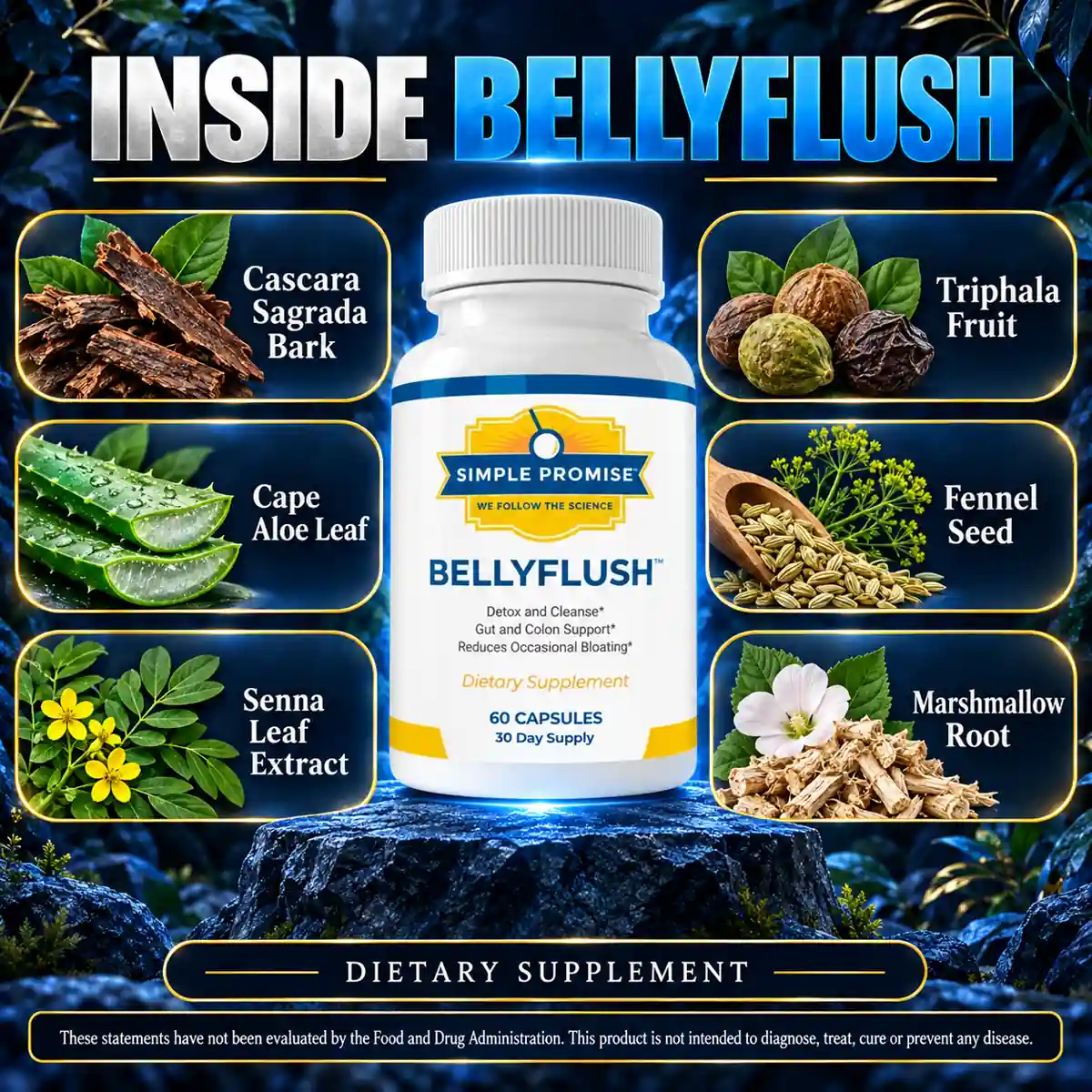
The vendor panel shows six of the eleven names. No milligram figure appears on it.
The full BellyFlush panel
Eleven names, their identities, roles and declared amounts.
| Named on the label | Botanical name | Role | Amount |
|---|---|---|---|
| Cascara Sagrada bark | Rhamnus purshiana | Stimulant laxative | Not published |
| Cape Aloe leaf | Aloe ferox | Stimulant laxative | Not published |
| Senna leaf extract | Senna alexandrina | Stimulant laxative | Not published |
| Triphala fruit | Amalaki, Bibhitaki, Haritaki | Ayurvedic fruit blend | Not published |
| Fennel seed | Foeniculum vulgare | Carminative seed | Not published |
| Bentonite clay | Montmorillonite | Clay binder | Not published |
| Marshmallow root | Althaea officinalis | Demulcent root | Not published |
| Licorice root extract | Glycyrrhiza glabra | Demulcent root | Not published |
| Slippery Elm bark | Ulmus rubra | Demulcent bark | Not published |
| Cayenne pepper fruit | Capsicum annuum | Pungent fruit | Not published |
| Milk Thistle seed | Silybum marianum | Liver botanical | Not published |
Why the missing amounts matter more on BellyFlush than on most labels
On a vitamin C tablet a missing amount would be annoying. On a panel containing three stimulant laxatives it is the whole question: the difference between a mild overnight nudge and a purgative is dose and nothing else.
Consider the range. Pharmacy senna is standardised to a stated quantity of sennosides and people titrate up from one tablet. A generous herbal blend can carry several times that in a two-capsule serving. Both are legal, both look identical on this label, and the buyer finds out which they bought at about four in the morning.
Without amounts, no research below can be read across to this product. Morishita 2021 studied a stated dose. Penninkilampi 2017 pooled measurable intakes. A capsule that names an ingredient inherits none of that. Treat the first bottle as calibration, and read the side effects page first.
What would fix this. A panel listing each botanical with its milligram figure, the extraction ratio where an extract is used, and the sennoside content of the senna. Three lines of print. Until then, every claim about strength on any website selling this product, including this one, is an assumption.
Every BellyFlush ingredient, with the evidence
In label order, with the evidence for each.
Cascara Sagrada bark
Not published Rhamnus purshianaThe first of three stimulant laxatives here. Its anthraquinone glycosides pass the small intestine intact, colonic bacteria cleave them, and the freed anthrones stimulate the colon wall. Evidence: a century of use and very little modern controlled testing. the FDA's 2002 final rule states that cascara sagrada, including the bark, is not generally recognized as safe and effective in over-the-counter laxative drug products, because the data asked for were never submitted. That governs drug products, not supplements, so this capsule is lawful, and no sales page mentions it. Demarque 2018 links anthranoid cell toxicity to the side effects people report.
Cape Aloe leaf
Not published Aloe feroxThe dried latex from the leaf, not the clear inner gel sold for skin. That distinction matters more than any other here: the gel soothes, the latex is a powerful anthraquinone purgative, and a colon formula uses the latter. Evidence: aloe is the second ingredient named in the FDA's 2002 final rule, carrying the same finding for the same reason. the NCCIH aloe vera page sets out what is and is not known and notes the safety concerns with oral latex preparations. The one controlled constipation trial we can point at, Odes 1991, tested a combination containing celandine and psyllium too, so it cannot tell you what the aloe contributed alone.
Senna leaf extract
Not published Senna alexandrinaThe third stimulant laxative, and the only one with a solid modern trial record. Senna acts through sennosides, the same anthraquinone route, and it is the active ingredient in several pharmacy laxatives sold today. Evidence: Morishita 2021 is a randomized, placebo-controlled trial in adults with chronic constipation, comparing senna against magnesium oxide. a Cochrane review reviews the class more broadly, and the joint AGA and ACG guideline places stimulant laxatives in the recognised treatment ladder. The gap: every one of those describes a stated dose of sennosides. This label publishes none, so a reader cannot line this capsule up against any of them.
Triphala fruit
Not published Amalaki, Bibhitaki, HaritakiNot one fruit but three: amalaki, bibhitaki and haritaki, usually in equal parts. It is the mildest mover here and the one with the longest record of traditional use. Evidence: Tarasiuk 2018 is the most useful modern overview, covering what is proposed for functional gastrointestinal disorders and what has actually been measured. Munshi 2011 is an open-label prospective study of a triphala-based formulation in functional constipation. Open-label means everyone knew what they were taking, which is a real limitation in a symptom-reported condition where placebo response runs high.
Fennel seed
Not published Foeniculum vulgareA carminative, traditionally used to ease trapped wind and cramping. On a panel built around three purgatives, the carminatives make the experience tolerable rather than adding to the effect. Evidence: Portincasa 2016 is a randomized trial of curcumin and fennel essential oil in irritable bowel syndrome that reported improved symptoms and quality of life. It used an essential oil at a stated dose inside a two-ingredient combination. This label names fennel seed with no amount and no extraction detail, so the read-across is weak. Hawrelak 2020 is the wider systematic review and the better place to start.
Bentonite clay
Not published MontmorilloniteA swelling volcanic-ash clay with a strong negative surface charge, which is why it binds positively charged molecules and why it turns up in cleanse formulas. Evidence: there is no controlled human trial of oral bentonite for bloating or colon health that we are willing to cite as support. What we can point at is the safety literature: Al-Rmalli 2010 measured arsenic and other toxic elements in clay eaten traditionally, which is why the source matters. This desk has seen no heavy-metal certificate for this one. Practical point: a binder can bind medication. Keep this capsule at least two hours away from anything prescribed.
Marshmallow root
Not published Althaea officinalisMucilaginous. In water it forms a slippery gel, and that gel is the whole traditional rationale: it coats and soothes a stimulated bowel. Evidence: the mucilage itself is well characterised, and Rownaghi 2024 measured the extracted polysaccharide in detail. What does not exist, as far as we can find, is a randomized controlled trial of oral marshmallow root for any digestive endpoint in adults. We say that plainly rather than citing a laboratory paper as if it were a clinical result. the NIH Office of Dietary Supplements is a short primer on reading that difference.
Licorice root extract
Not published Glycyrrhiza glabraThe ingredient here that most deserves a warning, and the one buyers underestimate because it is also a sweet. Evidence for: Raveendra 2012 is a randomized, double-blind, placebo-controlled trial of a standardised licorice extract in functional dyspepsia that reported symptom relief, and the NCCIH licorice root page summarises the plant and its cautions. Evidence against taking it casually: Penninkilampi 2017 pooled the studies on consistent licorice intake and found an association with raised blood pressure and lowered potassium. Glycyrrhizin lets cortisol act on the kidney's mineralocorticoid receptor, imitating excess aldosterone, and the three laxatives push potassium the same way. The label does not say whether the extract is deglycyrrhizinated.
Slippery Elm bark
Not published Ulmus rubraThe second demulcent, and traditionally the gentler one. Slippery elm inner bark forms the same kind of mucilage as marshmallow root. Evidence: Hawrelak 2010 is a pilot study of two natural medicine formulations in irritable bowel syndrome, one of which contained slippery elm. It is small, it is a pilot, and the herb sat inside a combination. That is the honest state of the evidence, and Hawrelak 2020 places it in the wider picture. Nobody has run a properly powered trial of slippery elm alone for bloating.
Cayenne pepper fruit
Not published Capsicum annuumOn this panel as a traditional circulatory and digestive stimulant. Its active compound is capsaicin, the molecule responsible for heat. Evidence: capsaicin unquestionably does something in the gut. Fuhrer 2011 gave an oral capsaicin load to people with functional dyspepsia in a placebo-controlled trial and measured the response. The direction of that response is the part most product pages leave out: in sensitive people capsaicin provokes symptoms rather than settling them. If chilli already gives you heartburn, this is an ingredient to notice on the label rather than to welcome.
Milk Thistle seed
Not published Silybum marianumThe only ingredient here not aimed at the bowel. Milk thistle seed provides silymarin, and it supports the word detox on the front of the bottle. Evidence: silymarin is genuinely well studied by botanical standards. Li 2024 is a systematic review and meta-analysis in fatty liver disease, and the NCCIH milk thistle page gives the balanced read. Neither licenses loose use of the word detox: those trials studied people with a diagnosed liver condition, at standardised doses, over months. Note on the picture: the vendor art illustrates this with the milk thistle flower. The label names the seed, which is where silymarin concentrates.
Sources cited on this BellyFlush page
Six sources for the claims above. Each botanical links its own research inline, and the full list sits on the home page.
- U.S. Food and Drug Administration. Status of Certain Additional Over-the-Counter Drug Category II and III Active Ingredients. Final rule, 67 FR 31125, 9 May 2002. Aloe and cascara sagrada in OTC laxative drug products are not generally recognized as safe and effective. https://www.federalregister.gov/documents/2002/05/09/02-11510/status-of-certain-additional-over-the-counter-drug-category-ii-and-iii-active-ingredients
- Morishita D, Tomita T, Mori S, et al. Senna Versus Magnesium Oxide for the Treatment of Chronic Constipation: A Randomized, Placebo-Controlled Trial. Am J Gastroenterol. 2021;116(1):152-161. https://pubmed.ncbi.nlm.nih.gov/32969946/
- Penninkilampi R, Eslick EM, Eslick GD. The association between consistent licorice ingestion, hypertension and hypokalaemia: a systematic review and meta-analysis. J Hum Hypertens. 2017;31(11):699-707. https://pubmed.ncbi.nlm.nih.gov/28660884/
- Al-Rmalli SW, Jenkins RO, Watts MJ, Haris PI. Risk of human exposure to arsenic and other toxic elements from geophagy: trace element analysis of baked clay using inductively coupled plasma mass spectrometry. Environ Health. 2010;9:79. https://pubmed.ncbi.nlm.nih.gov/21182763/
- Li S, Duan F, Li S, Lu B. Administration of silymarin in NAFLD/NASH: A systematic review and meta-analysis. Ann Hepatol. 2024;29(2):101174. https://pubmed.ncbi.nlm.nih.gov/38579127/
- Hawrelak JA, Wohlmuth H, Pattinson M, et al. Western herbal medicines in the treatment of irritable bowel syndrome: A systematic review and meta-analysis. Complement Ther Med. 2020;48:102233. https://pubmed.ncbi.nlm.nih.gov/31987249/

Every page, every journal post, the bottle facts and the ingredients go through review by Alyssa Simpson, RDN before they ship. We write these pages from the BellyFlush label and this desk’s own order paperwork, cite published research for each named botanical, and print “not published” wherever a figure is not disclosed rather than estimating it. The seal beside this note names no clinician, and we treat it as a manufacturing statement rather than a medical endorsement. Corrections are made on the page and the review date moves forward. Write to [email protected]. Last reviewed September 2026 by Alyssa Simpson, RDN.
Order BellyFlush with the panel in front of you.
Eleven named botanicals, no published amounts, and a website that says so before you buy rather than after.
$198 for six bottles, $33 each
Order BellyFlush On The Official WebsiteOne-time payment · no subscription · 365-day money-back guarantee · lot BEL-26/BE-3584