BellyFlush Official Website › Blog › What Is in BellyFlush?
What Is in BellyFlush? The Eleven Ingredients, Listed One by One
BellyFlush lists eleven botanicals: cascara sagrada bark, cape aloe leaf, senna leaf extract, triphala fruit, fennel seed, bentonite clay, marshmallow root, licorice root extract, slippery elm bark, cayenne pepper fruit and milk thistle seed. No amount is published for any of them. Three are stimulant laxatives.
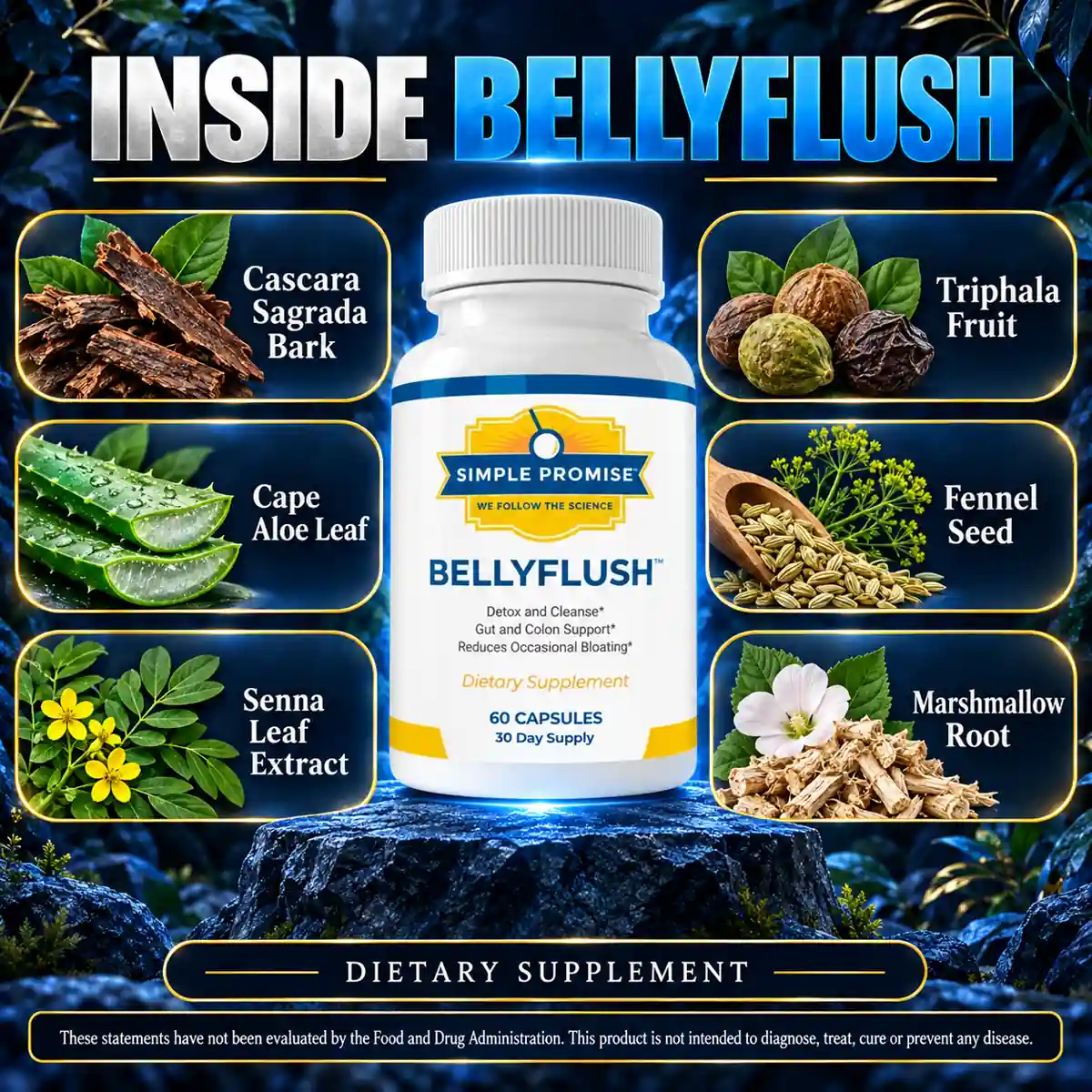
- Form: a capsule, not a tablet, pill, gummy, drop or powder. 60 capsules per bottle.
- Eleven botanicals are named. The amount is not published for all eleven.
- Cascara sagrada, cape aloe and senna leaf extract are the three stimulant laxatives.
- No extraction ratio is published for either extract, and no sennoside content is published.
- It is not stated whether the licorice root extract is deglycyrrhizinated.
What are the eleven BellyFlush ingredients?
Searches for the supplement facts, the ingredients list, the label and the pills, tablets or vitamins all lead to the same panel. The product is a capsule. This is the panel in label order.
| Named on the label | Plant | Role | Amount |
|---|---|---|---|
| Cascara Sagrada bark | Rhamnus purshiana | Stimulant laxative | Not published |
| Cape Aloe leaf | Aloe ferox | Stimulant laxative | Not published |
| Senna leaf extract | Senna alexandrina | Stimulant laxative | Not published |
| Triphala fruit | Amalaki, Bibhitaki, Haritaki | Ayurvedic fruit blend | Not published |
| Fennel seed | Foeniculum vulgare | Carminative seed | Not published |
| Bentonite clay | Montmorillonite | Clay binder | Not published |
| Marshmallow root | Althaea officinalis | Demulcent root | Not published |
| Licorice root extract | Glycyrrhiza glabra | Demulcent root | Not published |
| Slippery Elm bark | Ulmus rubra | Demulcent bark | Not published |
| Cayenne pepper fruit | Capsicum annuum | Pungent fruit | Not published |
| Milk Thistle seed | Silybum marianum | Liver botanical | Not published |
The roles above follow this desk's reading of the panel. They are not label claims.
Which three ingredients act as stimulant laxatives?
Cascara sagrada bark, cape aloe leaf and senna leaf extract. They share a chemical family called anthraquinones. The sugar-bound compounds pass the small intestine mostly untouched. Bacteria in the colon free the active part, which then prompts the colon wall to contract and to take back less water.
That chain takes hours, which is why the serving is placed at bedtime. The effect is usually described as 6 to 12 hours.
Cape aloe here means the dried latex of the leaf, not the clear inner gel sold for skin. Senna is the only one of the three with a solid modern trial record. A randomized, placebo-controlled trial, Morishita 2021, compared senna with magnesium oxide in chronic constipation. It used a stated dose. This label states none, so the trial cannot be read across.
Cascara sagrada and aloe were named in a 2002 FDA final rule (67 FR 31125) as not generally recognized as safe and effective in over-the-counter laxative drug products, because the data requested were not submitted. That rule governs drugs, not supplements.
What do the soothing ingredients add?
Four ingredients act as demulcents or carminatives. They are meant to change how the night feels, not to add to the laxative effect.
- Marshmallow root and slippery elm bark form a slippery gel in water. The idea is that the gel coats and soothes a stimulated bowel. No controlled trial of marshmallow root alone is cited here, and slippery elm has only a small pilot study inside a combination (Hawrelak 2010).
- Fennel seed is a traditional carminative, used for trapped wind. Portincasa 2016 tested fennel oil with curcumin in irritable bowel syndrome. That was a different preparation at a stated dose, so it does not apply to this capsule.
- Licorice root extract is the one to read twice. With consistent use, licorice can raise blood pressure and lower potassium (Penninkilampi 2017). The three laxatives push potassium the same way.
What are triphala, bentonite clay, cayenne and milk thistle doing here?
These four do not fit a neat box.
- Triphala is a blend of three fruits and the mildest mover on the panel. Tarasiuk 2018 is a review of what has been proposed for functional gut disorders. It is not a trial of this capsule.
- Bentonite clay is a swelling clay that binds. That is useful in a cleanse formula and awkward next to medicines, because it can bind them. Keep other tablets at least two hours away. A heavy-metal screen for this product is not published, which matters for a mineral ingredient (Al-Rmalli 2010).
- Cayenne pepper fruit carries capsaicin. In sensitive people an oral capsaicin load can provoke symptoms rather than settle them (Fuhrer 2011). If chilli gives you heartburn, notice this one.
- Milk thistle seed is the only ingredient not aimed at the bowel. Research on its silymarin is in people with a diagnosed liver condition at standardised doses (Li 2024). That does not turn a capsule into a detox for a healthy body.
What does the label leave out?
Beyond the missing amounts, several details are also not published.
| Detail | Status |
|---|---|
| Milligram amount for any of the eleven botanicals | Not published |
| Extraction ratio for the two extracts | Not published |
| Sennoside content of the senna | Not published |
| Whether the licorice extract is deglycyrrhizinated | Not stated |
| Heavy-metal screen | Not published |
| Full allergen statement | Not published; gluten-free, dairy-free and vegetarian marks are printed |
| Duration limit | None printed on the label |
Why does this matter so much? On a plain vitamin tablet a missing amount is annoying. On a panel with three stimulant laxatives it is the main question, because dose is what separates a mild nudge from a strong purge.
What is not in BellyFlush?
It has no probiotic, so it is not a gut flora product. It has no bulk fibre such as psyllium. It has no caffeine and no stimulant in the energy sense. The word stimulant in this post always means a stimulant laxative.
The label does not claim anything about weight, appetite, energy or immunity. Its three claims are Detox and Cleanse, Gut and Colon Support, and Reduces Occasional Bloating. They have not been evaluated by the Food and Drug Administration.
How should you use this list?
Treat bottle one as calibration, because nobody can tell you in advance how strongly it will act on you. Show the list to a pharmacist if you take any regular medicine. Say that it contains senna, cascara sagrada and cape aloe, and say licorice separately.
The label also carries non-GMO, vegetarian, gluten-free, dairy-free and natural-ingredients marks, plus a Doctor Formulated seal that gives no name or credential. This desk treats those as statements by the manufacturer about its own process. They are not tests, and they say nothing about the amounts.
General information, not medical advice. BellyFlush is a dietary supplement for healthy adults aged 18 and over. It is not a drug, it is not FDA approved, and it is not intended to diagnose, treat, cure or prevent any disease. No dietary supplement is FDA approved. Speak to a doctor or pharmacist before use if you take prescription medication, are pregnant or nursing, or have a diagnosed bowel condition.
Sources used
- FDA final rule 67 FR 31125 (2002). https://www.federalregister.gov/documents/2002/05/09/02-11510/status-of-certain-additional-over-the-counter-drug-category-ii-and-iii-active-ingredients
- Morishita 2021, Am J Gastroenterol. https://pubmed.ncbi.nlm.nih.gov/32969946/
- Penninkilampi 2017, J Hum Hypertens. https://pubmed.ncbi.nlm.nih.gov/28660884/
- Al-Rmalli 2010, Environ Health. https://pubmed.ncbi.nlm.nih.gov/21182763/
- Fuhrer 2011, Neurogastroenterol Motil. https://pubmed.ncbi.nlm.nih.gov/21883698/
- Li 2024, Ann Hepatol. https://pubmed.ncbi.nlm.nih.gov/38579127/
- Tarasiuk 2018, Chin Med. https://pubmed.ncbi.nlm.nih.gov/30034512/
- Portincasa 2016, J Gastrointestin Liver Dis. https://pubmed.ncbi.nlm.nih.gov/27308645/
- Hawrelak 2010, J Altern Complement Med. https://pubmed.ncbi.nlm.nih.gov/20954962/
- FDA, Questions and Answers on Dietary Supplements. https://www.fda.gov/food/information-consumers-using-dietary-supplements/questions-and-answers-dietary-supplements
Frequently asked questions
What is the full BellyFlush ingredients list?
Cascara Sagrada bark, Cape Aloe leaf, Senna leaf extract, Triphala fruit, Fennel seed, Bentonite clay, Marshmallow root, Licorice root extract, Slippery Elm bark, Cayenne pepper fruit and Milk Thistle seed.
How many milligrams of each ingredient are in BellyFlush?
Not published. No milligram figure appears on the bottle, the listing artwork or the paperwork supplied to this desk, so any claim about the dose is a guess.
Which BellyFlush ingredients are laxatives?
Three: cascara sagrada bark, cape aloe leaf and senna leaf extract. All three are stimulant laxatives from the anthraquinone family.
Is BellyFlush a tablet, a pill or a vitamin?
It is a capsule. A bottle holds 60 capsules, and the serving is two capsules with 8 oz of water, 20 to 30 minutes before bed.
Does BellyFlush contain probiotics or fibre?
No probiotic and no bulk fibre are on the panel. It is a blend of eleven botanicals, three of which are stimulant laxatives.
Is the licorice in BellyFlush deglycyrrhizinated?
It is not stated. Licorice root extract can raise blood pressure and lower potassium with consistent use, so ask a doctor or pharmacist if you take blood pressure medicine.
Our view
The ingredient list is short enough to read in a minute and thin enough to leave a gap you cannot fill. The names tell you what kind of product this is: an overnight stimulant laxative blend with soothing herbs around it. The missing amounts tell you how little you can know about its strength.
If that trade is acceptable, start small and keep notes. If you want to know your dose to the milligram, a product that prints it is a better fit.
Last updated . Medically reviewed by Alyssa Simpson, RDN.