BellyFlush Official Website › Blog › Labels With No Milligrams
How to Read a Supplement Label That Prints No Milligrams
A panel can take three shapes. It can print an amount beside every ingredient, it can hide everything inside a proprietary blend with one total, or it can simply name the ingredients and stop. The third is the most common in herbal formulas and the least discussed, and it is the shape the BellyFlush label takes.
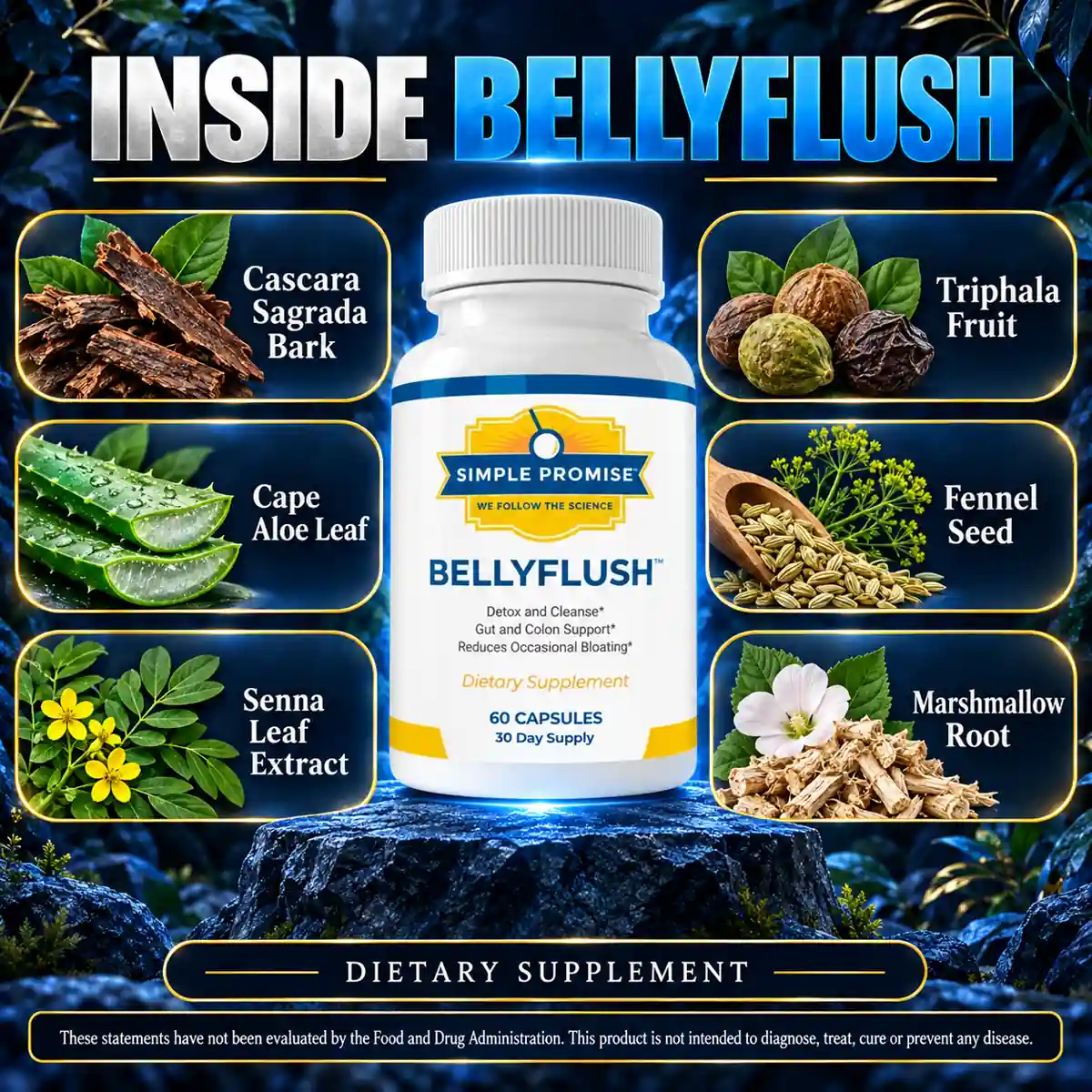
- Find the amounts column before you read a single ingredient name. Its absence tells you more than the marketing copy will.
- The word extract needs a ratio to mean anything, and a ratio is almost never printed.
- Standardisation is the third missing figure. For senna it is sennoside content, for licorice it is whether glycyrrhizin was removed.
- Unspecified is not the same as bad. It means the strength is unpredictable and the first bottle is a calibration exercise.
The three shapes a panel can take
| Shape | What you see | What you can work out |
|---|---|---|
| Fully specified | Every ingredient with a milligram figure | Everything. You can compare it against a published trial dose |
| Proprietary blend | A blend name and one total | A ceiling. No single ingredient can exceed the total |
| Names only | A list of ingredients, no figures at all | What is in it. Nothing about how much |
The middle shape is the one consumer advice usually warns about, and it is at least informative: a blend total is a ceiling, so a 500 mg blend of eight ingredients cannot contain 400 mg of any one of them without leaving very little for the rest.
The third shape gives you less than that, and it is rarely discussed. A list of eleven names with no total tells you nothing about proportion, nothing about strength and nothing that could be compared against any published study. the NIH Office of Dietary Supplements is a good primer on reading supplement labels generally.
Why it matters most on a laxative
On a vitamin C tablet a missing amount is annoying. On a stimulant laxative it is the whole question, because dose is the only thing separating a mild overnight nudge from a purgative.
Consider what a manufacturer can lawfully do. Pharmacy senna is standardised to a stated sennoside content and people titrate up from one tablet. A generous herbal blend can carry several times that in a two-capsule serving. Both are legal, both look identical on an unspecified label, and the buyer finds out which they bought at about four in the morning.
There is a second consequence for anybody who reads research. Morishita 2021 studied a stated dose. Penninkilampi 2017 pooled studies of measurable licorice intake. A capsule that merely names those ingredients inherits none of it, and a page implying otherwise is being careless with a reader’s trust.
The extract problem
Two of the eleven names on this label carry the word extract. An extract is not the ground herb, it is a concentrate, and the concentration is expressed as a ratio.
- Four to one means four parts of raw plant reduced to one part of powder.
- Twenty to one is five times stronger again at the same milligram figure.
- No ratio at all means the word extract is doing no work beyond sounding technical.
So two products naming the same ingredient at the same stated milligram figure can differ several-fold in what they actually deliver, and an unspecified extract with no figure at all sits outside that comparison entirely.
This is not an accusation of bad faith against any particular manufacturer. Most herbal blends are labelled this way, it is lawful, and it is the norm. It is simply the difference between a panel a pharmacist could evaluate in thirty seconds and one nobody can evaluate at all.
Standardisation, the third missing figure
Standardisation means the extract has been adjusted so that a named marker compound is present at a stated level. It is what makes one batch behave like the next.
For a laxative
The marker is sennoside content, usually a percentage or a milligram figure of sennoside B. Pharmacy laxatives print it because with this class of ingredient the marker is the dose.
For licorice
The marker is glycyrrhizin, and the question is whether it has been removed. A deglycyrrhizinated extract largely sidesteps the blood pressure and potassium problem that Penninkilampi 2017 describes. A standard extract does not. One word would settle it.
For a mineral ingredient
Bentonite clay raises a different question: source and purity rather than potency. Al-Rmalli 2010 measured arsenic and other toxic elements in clay eaten traditionally, which is why the origin of a clay matters and why a heavy-metal screen would be the reassuring document to see.
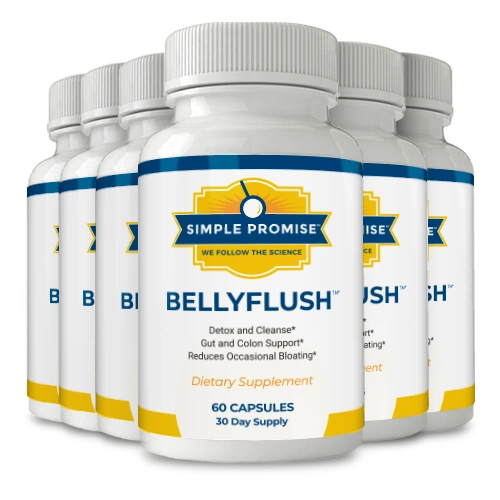
The panel this article is about.
BellyFlush names eleven botanicals and publishes no amounts. We print that, in a table, on the page with the order button on it.
$198 for six bottles, $33 each
Order BellyFlush On The Official WebsiteOne payment · no subscription · 365-day money-back guarantee
What a fully specified label would print
Worth writing down, because most people in this aisle have never seen one and therefore have no benchmark.
| Line | What it tells a buyer | Present here? |
|---|---|---|
| Milligrams per botanical | Strength, and whether any research applies | No |
| Extraction ratio per extract | How concentrated the extract is | No |
| Sennoside content | How hard the laxative half will act | No |
| Deglycyrrhizinated or not | Whether the blood pressure concern applies | No |
| Duration statement | How long it is meant to be taken for | No |
| Interactions on the pack | Whether to ask a pharmacist first | No |
| Certificate of analysis | Identity, heavy metals, microbial limits | Reference only |
That is seven extra lines of print and one document. None of it is a trade secret, because the ingredient list is already public. The reason it is rare is commercial: specification invites comparison, and an unspecified product cannot be compared with anything. the FDA explains the regulatory route that makes this possible.
Five questions worth asking a manufacturer
- How many milligrams of each botanical are in a serving? The answer, or its absence, is the whole article.
- What is the extraction ratio? Ask for both extracts by name.
- What is the sennoside content? A manufacturer that knows will answer in a sentence.
- Is the licorice deglycyrrhizinated? One word.
- Can I see a certificate of analysis for my lot? Quote the lot code from the base of the bottle.
Asking is worthwhile even when the answer is no. A manufacturer that answers four of five is a different proposition from one that answers none, and the responses accumulate into something genuinely useful for the next buyer.
BellyFlush scored in public
This desk sells BellyFlush, so applying the article to it is the only way the article is worth reading. Here is the result, without softening.
- Milligram figures: not published, for any of the eleven.
- Extraction ratios: not published, for either extract.
- Sennoside content: not published.
- Deglycyrrhizinated licorice: not stated.
- Duration limit: not on the label. This website states a position instead.
- Interactions: not on the label. Published in full on the side effects page.
- Certificate of analysis: a reference number is held, no laboratory report has been seen by this desk, and the regulatory position behind two of the ingredients is set out in the FDA's 2002 final rule.
Seven questions, seven blanks or partial answers. That is the honest score of the product on this website, and the reason it is published here rather than buried is that a reader who knows exactly which questions are unanswered is in a better position than one who has been reassured by a row of seals.
The full checklist guide takes this further, with nine checks and the same product scored against all of them.
What to do when the answer is not published
An unspecified panel is not a reason to abandon a purchase. It is a reason to change how you approach the first bottle, and there are four practical adjustments worth making.
- Treat bottle one as calibration. You are finding out what this particular product does to you, which is information you cannot get from the label. Start on a night before a morning you control.
- Do not stack anything. No second laxative, no magnesium preparation, no extra senna tablet because the blend feels mild. With an unknown dose you would be adding to a number you cannot see.
- Buy the smallest pack first. The per-bottle discount on a large pack is a poor trade against an unknown response, and thirty nights answers the question completely.
- Keep the packaging. The guarantee needs empty bottles back, and an unspecified product is precisely the kind you might want to return.
There is a fifth adjustment that costs nothing and helps everybody: ask. A manufacturer that receives the same five questions repeatedly starts answering them, and a label that gains a milligram column gains it because enough people asked for one. This desk has asked and will publish anything it is given.
In the meantime, the useful mental model is simple. A botanical name with no amount tells you what is in the bottle. A botanical name with an amount and a standardisation marker tells you what the bottle will do. Only the second is a specification, and only the second can be compared with a study.
General information, not medical advice. BellyFlush is a dietary supplement for healthy adults aged 18 and over. It is not a drug, it is not FDA-approved, and it is not intended to diagnose, treat, cure or prevent any disease. Constipation that is new, persistent or accompanied by pain, bleeding or weight change is a medical matter. Speak to a clinician before using any stimulant laxative product if you take prescription medication, are pregnant or nursing, or have a diagnosed bowel condition.
Sources
- Morishita D, Tomita T, Mori S, et al. Senna Versus Magnesium Oxide for the Treatment of Chronic Constipation: A Randomized, Placebo-Controlled Trial. Am J Gastroenterol. 2021;116(1):152-161. https://pubmed.ncbi.nlm.nih.gov/32969946/
- U.S. Food and Drug Administration. Status of Certain Additional Over-the-Counter Drug Category II and III Active Ingredients. Final rule, 67 FR 31125, 9 May 2002. Aloe and cascara sagrada in OTC laxative drug products are not generally recognized as safe and effective. https://www.federalregister.gov/documents/2002/05/09/02-11510/status-of-certain-additional-over-the-counter-drug-category-ii-and-iii-active-ingredients
- Penninkilampi R, Eslick EM, Eslick GD. The association between consistent licorice ingestion, hypertension and hypokalaemia: a systematic review and meta-analysis. J Hum Hypertens. 2017;31(11):699-707. https://pubmed.ncbi.nlm.nih.gov/28660884/
- Al-Rmalli SW, Jenkins RO, Watts MJ, Haris PI. Risk of human exposure to arsenic and other toxic elements from geophagy: trace element analysis of baked clay using inductively coupled plasma mass spectrometry. Environ Health. 2010;9:79. https://pubmed.ncbi.nlm.nih.gov/21182763/
- U.S. Food and Drug Administration. Questions and Answers on Dietary Supplements. https://www.fda.gov/food/information-consumers-using-dietary-supplements/questions-and-answers-dietary-supplements
- National Institutes of Health, Office of Dietary Supplements. Dietary Supplements: What You Need to Know. https://ods.od.nih.gov/factsheets/WYNTK-Consumer/

Every page, every journal post, the bottle facts and the ingredients go through review by Alyssa Simpson, RDN before they ship. We write these pages from the BellyFlush label and this desk’s own order paperwork, cite published research for each named botanical, and print “not published” wherever a figure is not disclosed rather than estimating it. The seal beside this note names no clinician, and we treat it as a manufacturing statement rather than a medical endorsement. Corrections are made on the page and the review date moves forward. Write to [email protected]. Last reviewed September 2026 by Alyssa Simpson, RDN.